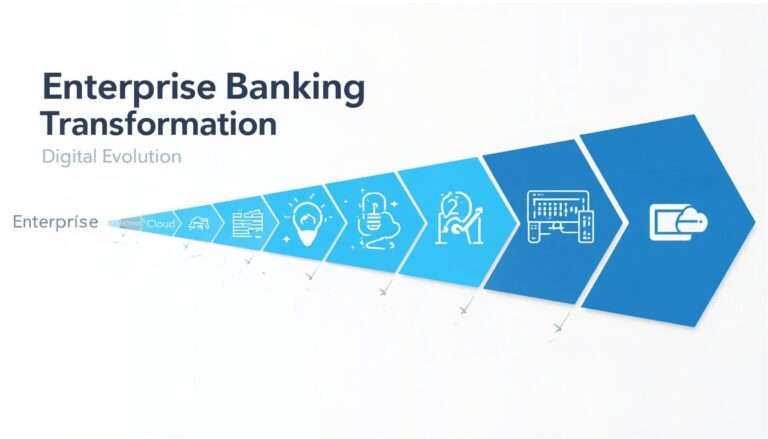
Building Enterprise Banking Capabilities for the Digital Finance Era
The Fintech Wizard Intelligence Strategic Briefing presents actionable frameworks for building enterprise banking capabilities that support real-time finance, regulatory fidelity, and profitable B2B platform economics in 2026. This briefing synthesizes infrastructure patterns, compliance automation, payment orchestration, and commercial models that matter to CIOs, CFOs, Heads of Innovation, and product leaders. The evidence reflects current market conditions: accelerated adoption of ISO 20022, central bank real-time rails growth, and rising regulator expectations for observability and data residency. The operational guidance here focuses on risk-adjusted returns, implementation speed, and measurable unit-economics improvements.
Enterprise Banking Architecture for Real-Time Finance
The enterprise banking architecture must transform ledgering, clearing, and client-facing primitives into composable, observable services that deliver sub-second decisioning and reconciled settlement visibility. Real-time finance requires a separation of concerns: event-driven transactions, a canonical balance model, and reconciliation as a continuous process. The architectural core should emphasize idempotent APIs, eventual consistency with strong reconciliation guarantees, and an audit-first ledger that supports both financial and regulatory use cases. The business meaning is simple: architecture must minimize capital tied up in float, reduce exception volumes, and accelerate cash conversion cycles.
Canonical Ledger and Event Fabric
The canonical ledger must provide a single source of truth for positions and obligations, with explicit support for multi-currency ledgers, multicounterparty netting, and regulatory reporting hooks. Implement a write-optimized primary ledger for control and a query-optimized read ledger for analytics and client APIs. Equip the ledger with cryptographic integrity checks and tamper-evident append-only sequences that tie into audit trails required by regulators. Operational reality requires automating reconciliation and provisioning near-instant settlement visibility to treasury desks and corporate clients, shrinking exception ratios and manual interventions.
Transaction processing must live on an event fabric that routes state changes to downstream systems in transactional order, ensuring compensating actions are deterministically applied. The fabric must support prioritized delivery for risk events, tempo controls to downstream legacy systems, and built-in observability for SLA measurement. Economically, the event fabric reduces headcount required for exception handling and enables dynamic routing to lower-cost settlement channels during peak windows.
CLOM: Continual Ledger Orchestration Model
Introduce the Continual Ledger Orchestration Model, CLOM, an operational model that treats reconciliation, settlement orchestration, and exposures as continuous flows rather than batch cycles. CLOM prescribes three layers: transactional capture, orchestration engine, and finality adjudication. The orchestration engine implements rules for netting, pre-funds checks, and routing to rails based on cost, compliance, and latency profiles. CLOM reduces time-to-final by converting manual batch fixes into deterministic automated compensations, lowering operational error rates and compressing working capital needs for enterprise clients.
CLOM also formalizes exception escalation tiers and integrates a feedback loop for machine-readable regulatory reporting. The model assigns KPIs at each layer: capture latency, orchestration decision time, and adjudication finality. Operational governance links these KPIs to SLAs and commercial guarantees, enabling pricing that reflects guaranteed settlement windows and dispute resolution timelines.
Bold Metric: 99.995% availability for core ledger write-paths. Strategic Takeaway: Guaranteeing sub-5ms commit latency and near-perfect availability materially reduces reconciliations and lowers capital costs for corporate treasuries.
Payment Orchestration, Compliance, and Platform Economics
Payment orchestration must unify connectivity to legacy rails, instant payment networks, and cross-border settlement venues while embedding compliance checks and dynamic routing rules that minimize cost and compliance friction. The orchestration layer must operate as a policy engine that optimizes for latency, fee, and legal constraints in real time. For enterprise banks and fintech platforms, orchestration converts infrastructural complexity into product-level differentiation and predictable unit economics.
Policy-Driven Routing and Compliance Hooks
A policy engine must evaluate each payment against a multidimensional rule set: counterparty risk profile, currency corridor availability, AML score thresholds, and preferred clearing rails based on cost and SLA. Embed RegTech hooks at decision points for identity verification, sanctions checks, and transaction monitoring scoring, with synchronous hold paths for high-risk events. Observability must capture policy decisions for auditability and regulator queries, and incident playback must be available for forensic reconstruction.
Operational designs must allow policy changes to be deployed as data-driven rules rather than code changes, enabling compliance teams to iterate quickly without engineering cycles. The performance imperative is to retain sub-second decision time even when invoking multiple live compliance systems, which requires parallelized scoring, local caching of regulatory lists, and staged holds with deterministic timeouts.
Platform Economics and Fee Stack
Platform economics depend on predictable take rates, settlement guarantees, and the ability to unbundle risk services such as escrow, FX, and reverse factoring. Price architecture must reflect the value of delivered SLAs: guaranteed settlement windows, chargeback arbitration, and regulatory compliance warranties. For B2B clients, monetize through layered offerings: connection, orchestration, settlement, and embedded treasury. Measure unit economics by contribution margin per transaction, CAC payback per client, and marginal cost per routing decision.
Strategically, reducing reconciliation and exception handling through orchestration lowers operational cost per transaction by up to 40%, while introducing premium SLA tiers enables margin expansion. The orchestration layer also becomes a marketplace: partners offering FX or lending can be surfaced with revenue share models, improving lifetime value for platform clients.
| Component | API Latency (avg) | Reconciliation Support | RegTech Hook | Unit Cost (USD) | Best Use Case |
|---|---|---|---|---|---|
| Instant Rail Adapter | 50ms | Real-time feeds | Core | 0.004 | Real-time payroll |
| Cross-Border Hub | 200ms | Netting + MT103/MT202 | Post-clearance | 0.12 | B2B supplier payments |
| On-Platform FX | 70ms | T+0 revaluation | KYC-linked | 0.02 | Embedded FX for marketplaces |
| Compliance Gateway | 80ms | Case workflow | Synchronous screening | 0.01 | High-risk corridor screening |
Bold Metric: Payment orchestration can cut exception handling costs by ~40%. Strategic Takeaway: Treat orchestration as a margin lever, not just a connectivity problem; monetize SLA and risk-wrapping services.
Digital Core and Data Fabric
The digital core must offer composable APIs, deterministic accounting rules, and a data fabric that supports analytics, regulatory reporting, and product innovation without duplicating ledgers. The business meaning is that flexibility in the core translates directly into time-to-market for new financial products and the ability to enforce consistent risk controls across channels. Enterprises must design for logical separation of data domains, with governed access and residency controls.
Composable APIs and Deterministic Accounting
APIs must expose financial primitives rather than product features, enabling product teams to assemble offers from balance operations, hold primitives, and settlement commitments. Deterministic accounting rules underpin every API, eliminating ambiguity in revenue recognition, fee application, and dispute resolution. The core should version accounting rules and maintain historical computation so that replays produce identical outcomes for audit purposes.
Operationally, enable product sandboxing against synthetic ledgers for testing, while enforcing data governance to prevent model drift. The API layer must include rate limiting, request tracing, and idempotency keys to prevent duplicate bookings; these controls directly lower operational risk and cost.
Data Fabric for Observability and Compliance
Implement a data fabric that stitches transactional events to customer profiles, risk signals, and regulatory reporting formats. The fabric should support near-real-time pipelines that produce normalized views for AML, fraud, and liquidity management. Use columnar stores for analytics, streaming materialized views for tactical workflows, and policy-driven retention that satisfies cross-border data residency laws.
The data fabric enables advanced pricing, anomaly detection, and stress testing without moving sensitive data between jurisdictions. For governance, instrument data lineage and create immutable audit logs that regulators can query with guaranteed SLAs.
Bold Metric: 30–50ms median query time for operational views under load. Strategic Takeaway: Fast, governed data access turns compliance obligations into a revenue asset by enabling chargeable observability and analytics products.
Risk, Compliance, and RegTech Automation
Risk and compliance frameworks must become programmable, measurable, and integrated into the transaction lifecycle to avoid post facto remediation and fines. The institution must quantify compliance as a forward-looking operating expense with metrics tied to regulatory risk appetite and capital provisioning. Automating controls reduces both regulatory friction and operational drag.
Programmable Controls and Continuous Compliance
Embed programmable controls at entry points: onboarding, payment initiation, and settlement reconciliation. Continuous compliance means enforcing rules in-flight, logging decision rationales, and escalating edge cases to human adjudicators with complete context. The system must support policy simulation so that new regulatory rules can be stress-tested against historical events before production rollout.
The ROI for programmable controls appears in reduced audit findings, lower capital held against unsettled exposures, and fewer regulatory levies. Metrics to track include policy hit rates, mean time to adjudicate exceptions, and the percent of rules executed synchronously versus asynchronously.
RegTech Integration and Forensics
Integrate specialized RegTech providers for sanctions screening, transaction monitoring, and identity verification with a standards-based API layer, ensuring fallback logic to in-house capabilities when third-party providers fail. Maintain an immutable forensic store that records raw inputs, decision outputs, and human overrides to satisfy supervisor investigations.
RegTech integration must include SLAs for explainability; regulators demand not just decisions but the evidence trail that led to them. Operational readiness requires runbooks for cross-border data requests and automated packaging of evidence for regulators.
Bold Metric: 60% reduction in manual review volume through automation. Strategic Takeaway: Treat RegTech integration as an operational multiplier; consistent evidence flow reduces regulator scrutiny and lowers required capital buffers.
B2B SaaS Unit Economics and Monetization
Enterprise banking platforms must translate technical capabilities into a predictable revenue model that aligns with client value and usage patterns. Pricing must reflect delivered outcomes: predictable settlement windows, reduced float, and lower reconciliation costs. Unit economics must be measured at the client-segment level, not as platform averages.
Pricing Architecture and SLA Monetization
Design pricing layers: a connection fee, an orchestration fee per transaction, premium SLA fees, and optional risk services. Price transparency matters; provide clients with modeled TCO comparisons that demonstrate savings versus legacy banking. Use contract terms that include performance credits for SLA breaches, shifting some operational risk back to the provider for premium pricing.
Measure CAC payback against multi-year client LTV that includes ancillary services such as working capital, FX hedging, and analytics. The ability to cross-sell treasury products increases retention and improves lifetime unit economics materially.
Channel Economics and Partnership Models
Create partner programs that expose orchestration as a managed service for fintechs, platform-as-a-service for corporates, and white-label banking stacks for non-bank enterprises. Structure revenue share and margin splits around contributed value: who provides compliance capability, who assumes settlement risk, and who owns the customer interface.
Operational governance must monitor partner performance and enforce SLAs through automated reconciliations and periodic audits. The platform should support escalation economics where higher-margin services subsidize lower-margin rails for scale.
Bold Metric: 18–24 month CAC payback for premium enterprise clients. Strategic Takeaway: Tie premium pricing to measurable reductions in working capital and exception costs to maintain gross margins as volumes scale.
Implementation Roadmap and Change Management
Implementation requires a phased approach that delivers early client value, validates operational assumptions, and builds governance muscle. The roadmap must sequence ledger modernization, orchestration deployment, and RegTech integration while running legacy systems in parallel until finality thresholds and reconciliations meet governance criteria. Execution speed matters, but controlled rollouts protect capital and regulatory standing.
Phased Delivery and Risk Mitigation
Phase 1: Deploy canonical ledger and core APIs with internal client pilots to validate CLOM flows and reconciliation SLAs. Phase 2: Introduce payment orchestration with compliance hooks and selective live corridors. Phase 3: Scale with partner integrations, premium SLA offerings, and monetized analytics. Each phase must have exit criteria tied to KPIs: reconciliation discrepancy rate, decision latency, and compliance false positive rates.
Mitigate risk using shadow-mode deployments, synthetic traffic, and staged cutovers for high-risk corridors. Governance must include a change approval board with representation from compliance, product, operations, and finance to avoid downstream surprises.
Organizational Change and Capability Build
Build cross-functional squads that own outcomes rather than components, pairing product with compliance and platform engineering. Invest in retraining operations staff to handle exception adjudication with tools rather than spreadsheets. Incentivize teams on operational KPIs such as mean time to finality and exception reduction.
Operational readiness plans must include playbooks for regulatory inquiries, disaster recovery scenarios, and customer communication templates for settlement incidents.
Bold Metric: Reduce time-to-market for new payment products from 9 months to 60 days. Strategic Takeaway: Rapid, governed delivery creates first-mover advantages in corridors where incumbents still operate with batch processes.
FAQ
How should enterprise banks prioritize ledger modernization versus payment rail connectivity when capital and time are constrained?
Prioritize the canonical ledger and reconciliation automation first, because connectivity without reliable finality increases operational exposure and capital drag. A modern ledger reduces exception volumes and provides the determinism needed to onboard real-time rails safely. Implement minimal viable adapters for key rails concurrently, using the ledger to absorb transient inconsistencies. Measure success by exception rate reduction and time-to-final benchmarks, not simply by number of rails connected.
What are the key SLAs and contractual constructs that make orchestration monetizable with enterprise clients?
SLA constructs must include settlement window guarantees, exception resolution timelines, and transparent fee schedules tied to delivered finality. Include service credits, dispute arbitration timelines, and performance-based pricing for premium corridors. Contractualizing compliance warranties and audit support creates a premium tier. Ensure metrics are measurable and auditable, with clear escalation paths and liability caps aligned to risk appetite.
How can CLOM reduce capital trapped in multi-jurisdictional netting and settlement processes?
CLOM minimizes batch-induced float by enabling continuous netting and dynamic routing to finality rails based on cost and risk profiles. The orchestration engine executes pre-funded checks and selective netting windows to lower intraday exposures. By compressing the time to adjudication and automating compensating entries, CLOM reduces unsettled balances and the capital needed to buffer settlement volatility.
What governance frameworks are required to satisfy European and APAC regulators when offering cross-border orchestration?
Adopt a single program-level governance model with localized operating rules and data residency enforcement. Implement documented policy matrices mapping product features to jurisdictional requirements, and maintain a forensic evidence store for supervisory review. Include local legal sign-offs for service terms, integrated sanctions and KYC controls, and clear escalation protocols. Regulator engagement plans must show technical proofs of auditability and incident response readiness.
What are realistic unit-economics targets for a B2B payment platform in the first three years of scaling?
Target contribution margins above 40% on premium services within 24 months by capturing orchestration fees and value-added treasury services. Aim for per-transaction marginal costs to decline by at least 35% as exceptions and reconciliation automation scale. CAC payback should fall to 18–24 months for enterprise clients; prioritize high-retention segments where cross-sell opportunities for FX and working capital exist to lift LTV.
Conclusion: Building Enterprise Banking Capabilities for the Digital Finance Era
Building enterprise banking capabilities for the digital finance era requires an operational lens: canonical ledger integrity, programmable orchestration, and deterministic compliance controls deliver measurable reductions in float, exceptions, and regulatory exposure. CLOM operationalizes continuous reconciliation and finality, converting technical capability into commercial leverage. Platform economics depend on SLA monetization and partner channels that expand reach without compromising governance. Execution needs phased delivery, shadow testing, and governance tied to clear KPIs.
Forecast (next 12 months): Expect accelerated adoption of ISO 20022-based instant rails across APAC and EU corridors, increasing demand for orchestration services that optimize cost and compliance. Regulators will require stronger evidence trails and faster response SLAs, driving higher integration of RegTech and forensic stores. Pricing will shift toward outcome-based SLAs, with incumbents and fintechs competing on guaranteed finality. Investment will concentrate on data fabrics and ledger robustness; firms that achieve consistent reconciliation automation and under-24-hour CAC payback for enterprise clients will dominate corridor economics.