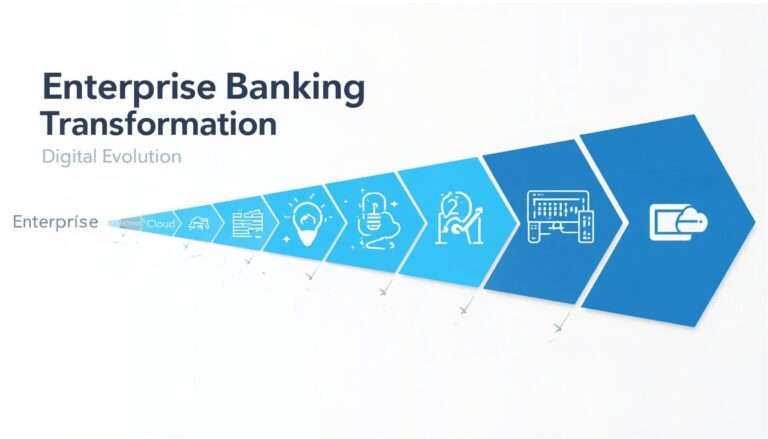
Digital Banking Maturity Models and Their Impact on Competitive Positioning
The Fintech Wizard Intelligence Strategic Briefing frames how maturity models for digital banking drive competitive positioning across product, operations, and regulatory domains. This briefing offers actionable frameworks, operational metrics, and an original model that institutional leaders can apply to prioritize investment, de-risk transformation, and measure market advantage through 2026 realities.
The evidence suggests digital banking maturity ceases to be theoretical and becomes a measurable, finance-grade asset class: orchestration stack quality, payments latency, reconciliation automation, and compliance automation deliver measurable margin and growth differentials. The briefing presumes multi-jurisdictional operations, cloud-native infrastructure choices, and near-real-time payment expectations across interbank rails and corporate treasury clients.
This document addresses CIOs, CFOs, Heads of Innovation, and product leaders who must convert technical maturity into unit-economics, pricing power, and lower capital-at-risk. Expect prescriptive architecture, a named operational model, a comparative table, and a concentrated FAQ that tests the model against common enterprise scenarios.
Digital Banking Maturity Models and Competitive Edge
Digital banking maturity determines whether a provider competes on price, speed, or embedded value propositions.
Maturity translates into shorter settlement cycles, predictable liquidity costs, and the ability to price value-added services to corporate clients. Institutions at higher maturity levels demonstrate lower operational exception rates and reduced float costs, directly improving net interest income and fee margins. The first-order commercial consequence appears in bid/ask spreads for on-platform FX, merchant acquiring rebates, and treasury service pricing.
Maturity models must link capability to commercial outcomes, not functionality to checklists. Operational capability to support event-driven reconciliation reduces straight-through processing exceptions from the industry baseline of 2.5 percent to sub-0.5 percent, cutting manual processing costs and claim liabilities. When a bank reduces reconciliation exceptions, the sales team can offer guaranteed SLA credits and tiered pricing, converting reliability into revenue and reducing churn for high-value business customers.
Competitive differentiation requires translating maturity into measurable KPIs tracked alongside product P&L. Track API latency, end-to-end settlement time, SLA breach rate, exception volume per 10k transactions, and cost-per-transaction. Those metrics drive investment prioritization and contract negotiation leverage with large corporate clients and marketplaces. Operational reality requires that boards treat digital maturity metrics as leading indicators of market share movement in payment-intensive segments.
Strategic Takeaways: 3-year ROI target 20–35%, API uptime 99.95%, STP rate >99%, exception rate <0.5%
Maturity Model Taxonomy
Banks and fintechs should adopt a taxonomy that separates foundational capabilities, orchestration, and product embedding. Foundational capabilities include ledger integrity, secure identity, and settlement connectors. Orchestration covers routing logic, dynamic routing based on cost and risk, and reconciliation automation. Product embedding focuses on SDKs, partner APIs, and white-label capabilities that create sticky revenue.
A clear taxonomy simplifies gap analysis and investment sequencing. Finance teams can map cost centers to maturity gaps and calculate payback periods for each capability, which informs phase-gate funding for digital transformation. The taxonomy also aligns procurement on vendor selection: buying a ledger is not equivalent to procuring an orchestration layer.
Institutions should convert taxonomy items to contractual KPIs in supplier agreements. For example, procure API gateways with guaranteed throughput and per-request SLAs tied to credits. Legal and procurement metrics become levers that ensure vendor performance supports competitive positioning.
Assessing Competitive Position
Competitive position emerges from the intersection of product depth, operational resilience, and integration footprint. A market entrant with a broad API ecosystem and an orchestration engine that optimizes cost and risk will extract higher take rates in embedded finance plays. Legacy banks can win with balance-sheet advantages if they accelerate settlement and lower counterparty risk for clients.
Measure position using transaction cohorts and revenue uplift per enabled feature. Compare cohorts that receive instant settlement, real-time reporting, or embedded credit against control groups. Those comparative experiments quantify how maturity converts into higher wallet share and lower attrition.
Operational maturity also affects regulatory standing and the bank's ability to bid for public sector or institutional mandates. Regulators increasingly equate demonstrable automation, observability, and audit trails with operational risk reduction. Presenting maturity metrics in regulatory filings produces downstream advantages in capital allocation and product approval timelines.
Operational Maturity, Payments, and Market Positioning
Operational maturity directly reduces payment friction and creates pricing power in high-volume B2B channels.
Operational maturity shortens reconciliation cycles and enables deterministic routing decisions that balance cost, latency, and regulatory constraints. For treasury clients, that means predictable intraday liquidity positions and the potential to monetize faster settlement through premium pricing. For marketplaces, reduced disputes and faster payouts translate to higher seller retention and platform growth.
Operational investments must prioritize end-to-end observability, rule-based exception handling, and automated remediation. Observability instruments should move beyond logs to structured telemetry: per-transaction state transitions, routing decisions, and reconciliation deltas. That data feeds automated decisions that reduce manual interventions and support SLAs required by enterprise clients.
Payment orchestration needs to handle heterogeneous rails, local compliance nuances, and liquidity optimization. Operational maturity includes a payments decision engine that selects rails based on cost, risk profile, and settlement time, while maintaining auditability. The business case shows that routing optimization and reduced exception processing lower variable cost per transaction and improve the economics for embedded finance offerings.
Strategic Takeaways: Payment routing optimization can cut per-transaction cost by 15–40% depending on volume and rail diversity
Payment Workflow Economics
Payment workflow economics depend on routing, reconciliation, exception handling, and liquidity management. Each step contributes to cost-per-transaction and settlement risk. High-volume clients expose inefficiencies quickly; small percentage improvements in STP rates scale into meaningful margin improvement. Under current 2026 rail mixes, cross-border payouts remain the largest cost driver unless routing and FX execution optimize against multiple liquidity pools.
Model the workflow economics with scenario-based simulations: volume curves, exception rates, settlement windows, and funding costs. Use those scenarios to price SLAs and to design incentive structures for sales teams. Sales compensation tied to percent reduction in client exception rates incentivizes cross-functional delivery.
Operational reality requires overlaying regulatory constraints on routing. For example, some jurisdictions impose inbound clearing rules or require local clearing entities. The payments decision engine must incorporate regulatory metadata as a cost factor, not an afterthought.
Market Positioning Through Operations
Operations define go-to-market options: white-label services, embedded finance APIs, balance-sheet lending, or pure platform models. Each model depends on operational maturity in different proportions. White-labels need multi-tenant isolation and custom routing, while embedded APIs lean on consistent developer experience and SDKs. Balance-sheet products require robust credit decisioning integrated into payment flows.
Positioning requires mapping operational strengths to market segments with favorable unit economics. Large corporates with predictable volume and complex treasury needs value settlement certainty more than price. Small platforms prioritize time-to-integration and developer support. Use customer segmentation to match operational investments to revenue expansion opportunities.
Operational transparency also reduces commercial friction. When legal and procurement can read machine-generated audit trails and SLAs, contracts close faster and with fewer price concessions.
Architecture, Integration, and API-Driven Economy
Clear architecture converts technical maturity into measurable commercial leverage.
A modular, API-first architecture reduces time-to-market and supports composability of payment, KYC, and accounting services. Firms with consistent API contracts and semantic stability reduce developer onboarding time from weeks to days, which accelerates partner integrations and revenue ramp. Standardized APIs also enable reuse across product lines, lowering marginal integration costs.
Integration strategy must prioritize versioning, backward compatibility, and contract testing. Institutions should treat API compatibility as a product with release cadences informed by client adoption curves. Frequent breaking changes destroy partner trust and increase churn. The architecture must also include an orchestration layer that separates routing logic from core ledger functions, enabling independent scaling and faster feature delivery.
Operational interfaces need strong governance: access controls, rate limits, and observability. Governance should include programmable throttling and priority lanes for high-value clients. Architecture decisions must quantify the latency-cost trade-off and place telemetry at transaction boundaries.
Strategic Takeaways: Developer onboarding time <72 hours drives 2–3x faster revenue ramp; API latency <50ms for routing decisions reduces settlement failures materially
The Orchestrated Payments Maturity Model (OPMM)
I propose the Orchestrated Payments Maturity Model, OPMM, a five-level model that links capabilities to commercial metrics and implementation timelines. OPMM levels: 0 Siloed, 1 Connected, 2 Orchestrated, 3 Embedded, 4 Autonomous. Each level prescribes specific architecture elements, API contracts, and expected commercial outcomes, including payback periods and target STP rates.
OPMM supports decision-making by mapping strategic initiatives to measurable KPIs. For example, moving from Level 1 to Level 2 requires a routing engine and reconciliation automation, with expected STP improvement of 20–30 percent and payback within 18 months for high-volume corridors. Moving to Level 4 introduces ML-driven routing and autonomous remediation, further dropping exception rates and enabling premium SLAs.
The model creates a language for procurement, IT, compliance, and commercial teams. Use OPMM to stage milestone-driven financing, vendor selection criteria, and tranche-based capability rollouts.
OPMM Comparative Table
| Level | Core Capability | API Strategy | Expected Commercial Impact |
|---|---|---|---|
| 0 Siloed | Legacy ledgers, manual reconciliation | Point integrations, no versioning | High cost-per-transaction, STP 99%, competitive pricing power |
Risk, Compliance, and RegTech Maturity
Risk and compliance maturity determine operational leeway and influence capital costs.
Banks that embed compliance into transaction flows reduce friction and regulatory review times. RegTech maturity includes real-time sanctions screening, machine-readable policy rules, and continuous audit trails. Those controls reduce regulatory remediation costs and license the institution to scale across jurisdictions faster.
Operational risk becomes a commercial lever when RegTech capabilities allow the bank to offer delegated compliance services to partners. For example, offering a certified KYC pipeline with audit logs lowers partner onboarding cost and creates a stickier platform relationship. Capital allocation also follows compliance maturity: lower operational risk produces lower unexpected loss estimates and favorable internal capital transfers.
Measure compliance maturity by time-to-evidence for audits, false-positive rates in screening, and remediation throughput. Reducing false positives by targeted tuning and high-quality watchlists lowers manual review costs and accelerates customer onboarding.
Strategic Takeaways: False-positive reduction target 40–60%, audit evidence time <24 hours, remediation throughput scaled to peak volumes
RegTech Integration Patterns
Integrate RegTech at transaction ingress and at the orchestration decision points. Screening at ingress prevents bad actors from entering flows, while dynamic risk-scoring during routing supports treatment options such as delayed settlement, enhanced due diligence, or referral. Use ML models to prioritize investigator workload and to create explainable decision trails for regulators.
RegTech tools should expose semantic-level APIs for policy updates. Regulators increasingly request configurable controls and proof of testing. Build policy-as-code so compliance teams can version and test changes, and produce deterministic outputs for auditors.
Operational reality requires redundancy in screening vendors and data sources. No single supplier provides full coverage globally, and fallback logic for vendor outages must exist in the orchestration layer.
Supervisory Expectations and Market Consequences
Supervisors evaluate not only controls but demonstrable automation and incident response. Institutions with automated response playbooks and machine-generated audit logs receive faster regulatory clearances for new products and cross-border services. Conversely, institutions lacking automation face operational restrictions and higher provisioning.
Market participants adjust risk premia based on visible compliance posture. Corporate clients perform vendor diligence and will price-in higher risk provisioning for suppliers with poor automation. Therefore, compliance maturity feeds directly into sales cycles, contract terms, and deposit/treasury pricing.
Commercial Models, Unit Economics, and Partner Ecosystems
Commercial model choice depends on both maturity and unit economics.
Unit economics require granular allocation of variable costs: rails, FX, AML screening, exception handling, and customer support. High-maturity providers can move from purely transaction-based pricing to outcome-based or risk-based pricing because they can quantify and guarantee outcomes. Commercial creativity follows operational certainty.
Partner ecosystem design will determine who owns customer relationships, who owns data, and how revenue splits occur. Mature orchestration enables platform owners to monetize network effects through referral fees, intermediation margins, or co-branded products. Less mature providers must compete on price or on balance-sheet terms.
Model profitability at the cohort level and test pricing experiments. Offer controlled pilots with SLAs and price-premia tied to clear, measurable outcomes such as settlement time, exception rates, and finality guarantees. Data from these pilots informs broader pricing strategy and reveals which segments will bear premium pricing.
Strategic Takeaways: Target mid-run contribution margin improvement 8–15 percentage points from orchestration and automation investments
Pricing Strategies for Embedded Finance
Pricing for embedded finance must reflect the blend of variable costs and the value delivered. For instance, marketplace platforms willing to pay for instant payouts value reduced holdbacks and chargebacks more than basic settlement. Price accordingly: offer tiered pricing where faster settlement or enhanced fraud protection commands premium fees.
Use revenue attribution models to split fees across platform, bank, and ecosystem partners accurately. Transparency reduces commercial disputes and accelerates partner onboarding. Billing systems must be tied to event-level telemetry to produce auditable invoices.
Commercial teams should craft SLAs that deliver defensible commitments and model worst-case cost scenarios to avoid underpricing, which erodes long-term margins.
Ecosystem Governance and Data Rights
Ecosystem governance defines who controls client data and who can offer adjacent services. Contracts must specify data ownership, usage rights, and monetization splits. For platforms with multiple partners, governance bodies or standard contractual frameworks reduce negotiation friction.
Data rights matter for future product launches. If the bank retains access to transaction-level data, it can upsell treasury analytics and embedded lending. If partners retain exclusive ownership, the bank’s route to cross-sell narrows. Governance also affects compliance obligations, including data residency and consent management.
Implementation Roadmap and Measurement Framework
Implementation requires stage-gated milestones tied to commercial outcomes.
Stage gates should map to the OPMM levels and include measurable acceptance criteria: STP improvement, API stability, exception rate reductions, and go-to-market readiness. Tie funding tranches to measured results rather than time-based milestones. Operational reality shows funding shifts when early automation yields quicker-than-expected returns.
Measurement frameworks must combine telemetry, financial metrics, and regulatory KPIs. Create a dashboard that aligns technical metrics like API latency with financial metrics like cost-per-transaction and commercial metrics like net revenue per client. Boards and audit committees need a concise set of leading indicators to oversee delivery.
Execution teams require cross-functional squads with product, engineering, treasury, and compliance representatives. Institutional inertia often arises from siloed ownership of payments, ledger, and compliance. Creating empowered squads with clear P&L accountability reduces friction and accelerates maturity progression.
Strategic Takeaways: Use stage-gated funding with acceptance criteria: STP delta, exception rate target, API stability, and project payback horizon
Roadmap Phases and Timelines
Phase 0: Stabilize legacy flows and instrument observability, 3–6 months. Phase 1: Central ledger and basic API layer, 6–12 months. Phase 2: Orchestration and reconciliation automation, 9–18 months. Phase 3: Embedded SDKs and partner programs, 12–24 months. Phase 4: Autonomous optimization and predictive remediation, 18–36 months.
Use parallel tracks for risk and compliance workstreams to avoid sequential delays. Some capabilities, such as policy-as-code and audit trails, must progress early to reduce approval time for later phases.
Quantify expected payback per phase and require live experiments with anchor clients before full rollouts. Anchor clients provide production load and reveal edge cases that synthetic testing misses.
Measurement and KPIs
Track leading indicators: API error rates, STP percentage, exceptions per 10k transactions, mean time to reconcile, onboarding time for partners, and dispute resolution time. Map each metric to financial impact estimates, including reduced manual labor costs, faster cash conversion, and increased take rates.
Present measurement in a single view for the executive committee, linking technical graphs to P&L line items. Operational reality demands that measurement supports both tactical remediation and strategic investment decisions.
Executive FAQ
How should a regional bank prioritize investments when constrained by capital and facing large international fintech competitors?
Prioritize investments that reduce variable cost per transaction and deliver immediate client-facing benefits. Start with reconciliation automation to lower exception costs and shorten settlement ambiguity, then deploy a routing engine for high-cost cross-border corridors. Use anchor-client pilots to secure early revenue and offset capital spend. Negotiate vendor contracts with performance-based fees to mitigate upfront expenses. Finally, align the CFO and CRO on re-allocating capital from low-yield legacy products into core orchestration capabilities.
What metrics should a CFO require to validate that a payments orchestration project improves unit economics?
Require per-cohort, transaction-level metrics tied to cost and revenue: cost-per-transaction net of routing and screening, STP percentage, exceptions per 10k, average float days, and revenue uplift per enabled feature. Demand scenario-based payback analysis with sensitivity to volume shifts and rail fee volatility. Insist on reconciled P&L for pilot clients and an exhaustion schedule for manual intervention costs. These metrics enable realistic financial forecasting and capital allocation decisions.
For a multinational fintech, how does RegTech automation influence market expansion decisions into new jurisdictions?
RegTech automation shortens licensing and onboarding timelines by producing machine-readable evidence and deterministic compliance workflows. When automation handles jurisdictional screening and evidence collection, time-to-market drops and the incremental cost of entering new corridors declines. The fintech can prioritize jurisdictions where regulatory complexity currently blocks competitors. However, also validate data localization and vendor redundancy requirements early, because failure modes increase operational risk and negate speed advantages.
Can banks monetize higher maturity by offering compliance-as-a-service to partners, and what are the practical constraints?
Banks can monetize compliance-as-a-service by packaging certified KYC, AML screening, and audit trails as white-labeled modules with clear SLAs. Revenue models include per-screen fees, subscription arrangements, and outcome-based pricing. Practical constraints include proving jurisdictional coverage, maintaining vendor and data-source redundancy, and ensuring policy flexibility for partners. Legal frameworks must address shared liability and data rights. Start with limited-scope pilots for non-critical flows and expand coverage as control evidence accumulates.
How should product leaders choose between building in-house orchestration versus procuring a third-party platform?
Choose based on core differentiation and time-to-value. If orchestration becomes a strategic, customer-facing differentiator that enables pricing power, build to capture long-term margin. If time-to-market and capital limits dominate, procure a composable platform that supports vendor portability and contractual SLAs. Always require clear exit paths in procurement contracts, full data export capabilities, and a defined migration plan to avoid vendor lock-in. Pilot with a tranche of volume to validate operational assumptions before full-scale commitment.
Conclusion: Digital Banking Maturity Models and Their Impact on Competitive Positioning
The bank that treats digital maturity as a measurable, investable asset will gain predictable pricing power, faster regulatory approvals, and more efficient capital deployment. Implement the OPMM model to stage investments, tie vendor commitments to measurable KPIs, and use cohort experimentation to convert technical improvements into durable commercial advantages.
Summary strategic takeaways: prioritize reconciliation and orchestration to reduce exception rates below 0.5 percent; target API latencies under 50 milliseconds for routing decisions; aim for STP above 99 percent to justify premium pricing; pursue RegTech automation that reduces audit evidence time to under 24 hours. Use stage-gated funding linked to payback and operational KPIs. Align sales incentives with operational outcomes to ensure investments convert into retention and monetization.
Forecast for the next 12 months: providers that achieve Level 2 to 3 OPMM capabilities will capture disproportionate share in embedded finance and platform partnerships, driving a 10–20 percent reallocation of transaction volumes away from legacy processors. Regulators will increase focus on demonstrable automation and explainability, imposing shorter remediation windows that favor automated controls. Expect consolidation in payments orchestration vendors, with those offering strong RegTech integrations commanding premium valuations. Finally, liquidity and settlement optimization will grow as differentiators as cross-border volume normalizes post-2025 macro adjustments.
Tags: digital-banking, payments-orchestration, fintech-strategy, regtech, api-economy, operational-maturity, embedded-finance